
Why Liquid Rubber is the Most Versatile Tool in a Roofer’s Arsenal?
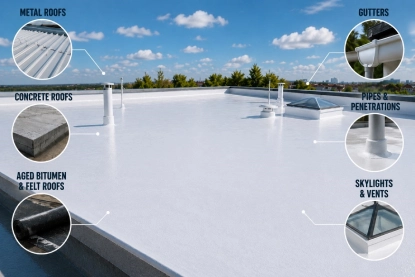
In the modern construction landscape, the demand for high-performance waterproofing has moved beyond simple patch repairs toward integrated, high-tech systems that ensure structural longevity. Liquid rubber has rapidly ascended to become the definitive “Swiss Army Knife” for roofing professionals, offering a level of adaptability that traditional materials like bitumen felt or EPDM sheets simply cannot match. By providing a monolithic, seamless barrier that conforms to any architectural complexity, this advanced technology allows roofers to solve a multitude of problems using a single chemistry.
1.The Technical Foundation: What Defines Modern Liquid Rubber?
Technically classified as a liquid-applied elastomeric membrane, these systems are engineered from high-grade synthetic polymers like EPDM or advanced polyurethanes. Unlike standard industrial paints that create a thin, brittle film, liquid rubber is formulated with high solids content to produce a heavy-duty skin. This molecular structure allows the material to act more like a “living” shield than a static coating.
The material undergoes a complex cross-linking process during curing, turning it from a fluid into a solid, waterproof barrier. This allows it to handle the physical stresses of the building, such as thermal expansion and minor settlement. Because it remains permanently flexible, it can stretch significantly and return to its original shape without structural fatigue.
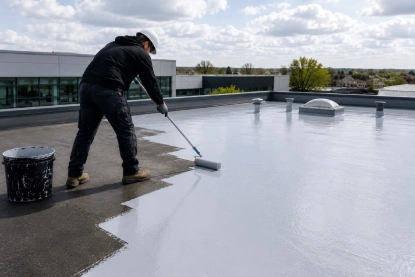
The primary advantage for a professional lies in the fluid state during application. It bypasses the physical limitations of sheet membranes, which require cutting, overlapping and mechanical fastening. As it cures, it forms a monolithic seal that blankets the entire roof surface without a single joint.
2.Unmatched Substrate Versatility
The roofer’s arsenal is often cluttered with substrate-specific products that limit productivity. Liquid rubber allows for a significant consolidation of materials because it can chemically bond to almost any common construction surface. Whether the project is a residential renovation or a massive industrial complex, a single system can often handle multiple roof types.
Substrates that can be successfully protected include:
- Concrete and Masonry: It fills microscopic pores, preventing capillary water ingress and protecting reinforcement steel from corrosion.
- Metal Roofing (CGI and Zinc): It provides an airtight seal that prevents rust and easily handles the high thermal expansion rates of metal sheets.
- Aged Bitumen and Felt: It rejuvenates old, brittle roofs, allowing for a full restoration without the need for a costly total tear-off.
- Wood and OSB: It creates a flexible, breathable, yet completely waterproof layer for modern timber-framed structures.
- PVC and Old GRP: It is an excellent choice for repairing old plastic or fibreglass roofs that have developed star-cracks over time.
3.The Molecular Science Behind Elongation
To understand why this tool is so vital, one must consider the concept of “elongation at break.” Most buildings are dynamic structures that move daily due to temperature shifts. Traditional rigid materials often snap or pull away from joints when this movement occurs.
High-performance liquid rubber membranes, such as those developed in FIXA’s R&D labs, can offer elongation rates of 600% to 800%. This means the membrane can stretch up to eight times its original size without tearing. Once the stress is removed, the material’s “thermal memory” pulls it back to its original dimensions.
This flexibility is what prevents leaks in the long term. Even if a building settles or the roof deck expands in the summer heat, the membrane remains uncompromised. It bridges existing hairline cracks and prevents new ones from reaching the surface.
4.Mastering the Complexities of Roof Detailing
One of the most risk-prone tasks in roofing is detailing skylights, vent pipes and parapet walls. Sheet-based systems require intricate cutting and the use of various tapes or metal trims to manage these transitions. Each of these mechanical joints introduces a potential site for a future leak.
Liquid rubber transforms this process into a straightforward “paint-to-fit” application. The roofer simply brushes or rolls the liquid around the penetration, ensuring 100% coverage in every crevice. The liquid forms a continuous bond to both the vertical upstand and the horizontal deck.
This “self-flashing” capability is a major time-saver on projects with high architectural complexity. There is no need for separate metal trims or awkward glassing in tight corners. The resulting seal treats a chimney or a vent pipe with the same level of security as a flat open area.
5.Cold-Applied Safety and Productivity
Safety is a paramount concern in modern construction, particularly regarding fire prevention. Liquid rubber is cold-applied, meaning it requires no dangerous gas torches or boiling bitumen kettles on the roof. This significantly reduces the fire risk for both the contractor and the building owner.
The productivity benefits of cold-applied systems include:
- Lower Insurance Premiums: Contractors often enjoy lower insurance costs when eliminating “hot works” from their operations.
- Fast Turnaround: Large commercial projects can be completed in a fraction of the time using airless spray equipment.
- Reduced Equipment Costs: There is no need to transport heavy gas bottles or melting equipment to the roof.
- Rapid Curing: Advanced formulas become “showerproof” in as little as 30-60 minutes, protecting the work from sudden rain.
- Ease of Maintenance: If a roof is ever damaged mechanically, a simple brush-on patch will chemically fuse with the original layer.
6.Performance Under Extreme Environmental Stress
The UK climate is notoriously difficult for roofing materials, characterized by rapid shifts from intense sun to heavy rain. Many materials fail because they cannot handle the resulting “thermal shock.” Liquid rubber is engineered with extreme thermal stability to survive these conditions.
It remains supple and functional at temperatures as low as -40°C. In the mid-summer heat, where roof temperatures can reach 80°C, it does not melt or lose its chemical stability. This wide temperature window ensures the building remains protected year-round.
Furthermore, these membranes are designed to withstand ponding water indefinitely. Unlike water-based acrylic paints that can re-emulsify and soften, a professional-grade membrane remains inert. This makes it the ideal choice for flat roofs where drainage may be less than perfect.
7.The Impact of “Roof Recovery” on Sustainability
The traditional approach to a failing roof has always been a total “strip and replace” operation. This process generates millions of tonnes of landfill waste annually and is extremely expensive. Liquid rubber offers a more sustainable path through what the industry calls “Roof Recovery.”
Instead of tearing off the old materials, professionals can use the existing roof as a solid substrate. After proper cleaning and priming, the liquid is applied directly over the old surface. This “upcycles” the existing structure and adds a new 20-year service life to the asset.
From an environmental perspective, this reduces the project’s carbon footprint significantly. There is less waste sent to the landfill and fewer new raw materials required for the structural deck. Additionally, many of FIXA’s liquid systems are low-VOC and solvent-free, making them safer for the planet.
8.Economic Efficiency: Short-Term vs. Long-Term
While the initial material cost of high-quality liquid rubber may be higher than felt, the total cost of ownership is lower. Labour is the most expensive part of any roofing project. Because liquid systems are faster to install, the total project cost is often reduced by 30-50%.
The lack of maintenance requirements further enhances the economic argument. There are no seams to inspect or joints to reseal every few years. A correctly installed system provides a “fit and forget” solution that lasts for decades.
Finally, the energy-saving potential of these systems should not be ignored. Many liquid membranes come in reflective white or light grey finishes. These “Cool Roof” systems reflect solar heat, lowering internal building temperatures and reducing the cost of air conditioning.
9.FIXA’s R&D: Engineering the Ultimate Tool
At FIXA, we don’t just supply a bucket of product. We view waterproofing as a science of layers, where each component must work in harmony. our R&D team focuses on “Nano-Bonding” technology to ensure maximum peel strength on every surface.
We prioritize formulations that are easy for the roofer to apply while delivering industrial-strength results. Our systems are often reinforced with specialized polyester fabrics to create a high-strength composite. This provides the puncture resistance of a rigid system with the flexibility of a pure elastomer.
When a roofer chooses FIXA, they are choosing a system that has been tested for UV stability and long-term impermeability. We provide the technical documentation and field support required for large-scale professional projects. Our goal is to ensure every structure we protect remains watertight for the next generation.
Securing the Future with Liquid Versatility
The evolution of liquid rubber has effectively consolidated the roofer’s toolkit into a single, high-performance solution. By replacing multiple rolls of sheet material and dangerous torches with an adaptable liquid, professionals can work faster and safer. Its ability to solve detailing challenges and bond to nearly any substrate makes it the most valuable asset for a modern contractor.
Choosing liquid-applied membranes is an investment in the future of the building. It provides an advanced chemical defense that adapts to movement and defies the aging effects of the environment.
Ready to experience the most versatile tool in the industry? Explore FIXA’s range of high-performance liquid rubber systems today or contact our technical team for a bespoke project specification.
For more information and quotations, please contact us at +44 (0) 2081760680 or via email at info@fixaco.uk
Frequently Asked Questions (FAQ)
Can liquid rubber be used to repair gutters and pipes?
Yes, this is one of its most versatile uses. Because it can be applied to metal, PVC and concrete, it is the perfect tool for lining leaking box gutters or sealing joints in drainage pipes permanently.
How long does a liquid rubber roof typically last?
When applied correctly as a full restoration system, a liquid rubber roof can easily last between 15 and 25 years. A simple “refresh” coat after two decades can extend the life even further.
Do I always need a primer before applying the liquid?
This depends on the substrate. Porous surfaces like old concrete or weathered bitumen usually require a primer to ensure a perfect bond. However, on most non-porous metals, the material can often bond directly after a thorough cleaning.
Can it be applied in cold weather?
Yes, many of FIXA’s advanced systems can be applied in temperatures as low as 5°C. The most important factor is that the surface is dry and free of frost during the application process.
Is it safe for the environment and aquatic life?
Many modern liquid rubber products are solvent-free and non-toxic once cured. Only specific formulations certified for “aquatic life” should be used for fish ponds, but standard versions are safe for general rainwater runoff.
Share!
Other Blog Posts
Other Blog Posts
Bitumen is one of the most important binding materials used […]

In modern structures, durability is becoming just as vital as […]
Modern bathroom design has shifted significantly toward high-end wet rooms […]
In the modern construction landscape, the demand for high-performance waterproofing […]

The window perimeter is one of the most technically demanding […]
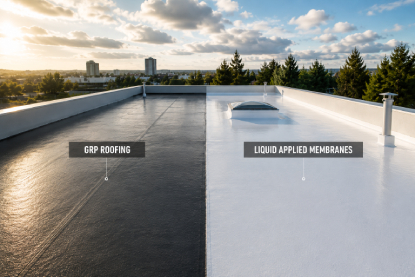
Choosing the right waterproofing system for a flat roof is […]
Flat roofs are a critical component of modern building design, […]
Epoxy-based reinforcement systems, when used in combination with carbon or […]

Digital transformation is a process in which companies respond to […]
