
DIGITAL TRANSFORMATION IN THE CONSTRUCTION INDUSTRY
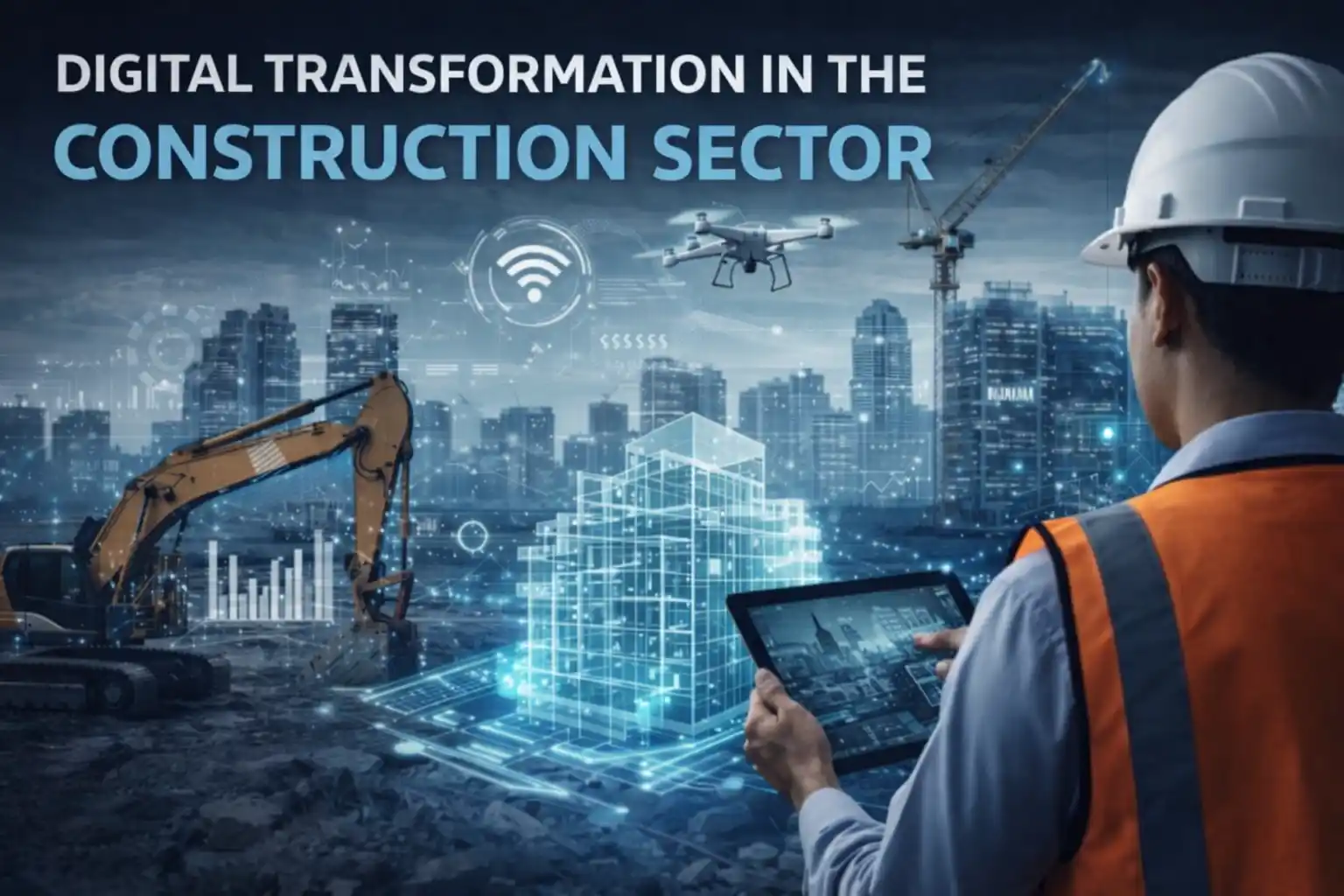
Digital transformation is a process in which companies respond to rapid changes in the business environment and transform their products, services and business models according to the needs of customers and society by using data and digital technology. This process is also defined as a whole where the business transforms itself, its organization, processes, corporate culture and climate, ultimately creating a sustainable competitive advantage.
1.Sectoral Challenges and the Necessity of Transformation
Today, the industry faces various challenges such as labor shortages, an aging workforce and skill turnover issues. To solve these problems, the strategic use of digital technology is essential for differentiating from competitors and creating a competitive advantage in the market. The use of technologies such as information and communication technologies, artificial intelligence, cloud computing and drones is of vital importance for creating an advanced management system suitable for the new era.
2. Three Main Benefits of Digital Technologies to the Construction Sector
Eliminating Labor Shortage: Creating a Structure That Is Not Dependent on Humans
One of the most important benefits provided by digital transformation is the elimination of the labor shortage, which is becoming increasingly serious in the construction sector. As the workforce ages and the number of young people joining the workforce decreases, companies need to establish production systems that are as independent as possible from individual skills in order to continue growing in the medium and long term. To achieve this, one of the key management issues is to reduce the number of people required and automate existing production processes.
Increasing Business Productivity: Reviewing General Business Operations
Facilitating Technology Transfer: Seamless Skill Transfer
The seamless transfer of skills through digitalization ensures that the qualifications held by the aging workforce are handed over to young and middle-aged workers without delay. Knowledge management is the method of converting “tacit knowledge” (advanced knowledge and techniques) held by skilled employees into explicit knowledge by making it verbalized or formulated. Sharing this knowledge across the organization thanks to digital technology not only facilitates skill transfer but also strengthens communication established with younger generations.
3.Agents” of Digital Transformation: Technologies Shaping the Future
Artificial Intelligence (AI): This technology, which reproduces human intelligence, is used in critical areas such as visualizing progress through the analysis of construction site images, determining structural design safety and digitizing the skills of master craftsmen.
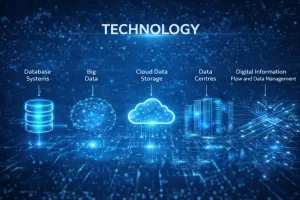
Cloud Services and SaaS (Software as a Service): Cloud (SaaS) services, which allow for location-independent data sharing, can be accessed from anywhere with an internet connection without requiring physical information technology (IT) infrastructure. They are indispensable for promoting information sharing across the company.

Drone Technology: It significantly reduces the number of workdays and the required personnel for tasks such as land surveying and high-altitude inspections. It is a fundamental technology for accurately understanding land topography and performing inspections at a low cost with fewer people.

ICT (Information and Communication Technology) Supported Construction Machinery: It enables the automation of heavy machinery control and operational guidance. By eliminating dependence on the operator’s personal experience, it increases productivity and quality maintenance.
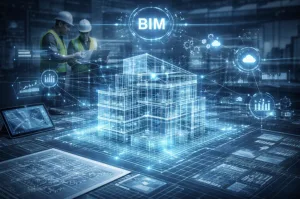
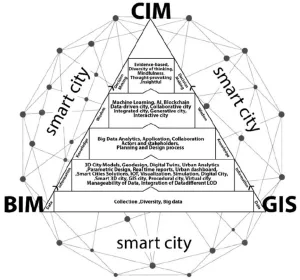
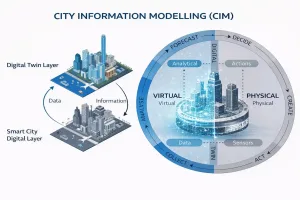
BIM and CIM: These facilitate production management by sharing information obtained from the planning, research and design stages through 3D models. BIM (Building Information Modeling) is used in the building sector, while CIM (City Information Modeling) is used in the civil engineering sector to reduce errors and rework.
4. Traditional Methods, Occupational Health and Safety (OHS)
Due to the construction sector involving “numerous analog processes,” digital adaptation may progress relatively slowly. However, significant progress is being made in areas such as remote construction management, paperless drawings, and drone-based surveying. Digitalizing skilled labor—such as formwork, rebar processing and the power trowel finishing of concrete floors—is more challenging and low IT literacy on construction sites remains a point of resistance.
Despite this, the impact of digital transformation on OHS is profound:
- It ensures that employees are removed from dangerous environments and that workloads are optimized.
- Work accidents are prevented by performing high-risk tasks with digital support.
- Employee health is proactively protected through the pre-detection of potential risks and real-time monitoring of safety measures.

5.Turkey and the Competitive Landscape
The construction sector, the locomotive of the Turkish economy, is a dynamic structure that feeds more than 200 sub-sectors. In this environment where competition is inevitable, adapting to digital transformation is a “turning point” for Turkish construction companies to make a difference.
It is critically important for our country, which ranked second in the world with 43 companies in the “World’s Top 250 International Contractors” list in 2024, to be a pioneer in this field and to set an example for other companies.
What Are the Contributions of Digitalization to Construction Chemicals Manufacturers?
- Fully Automated Production Facilities: By implementing fully automated production models in manufacturing facilities, the margin of error dependent on the human factor can be minimized and standard quality in production can be guaranteed through digital inspection.
- R&D and Digital Simulations: In laboratory processes, smart product formulations can be developed for waterproofing and structural reinforcement, which are the fastest-growing segments of the market. By simulating the field performance of products in a digital environment, digital data-driven solutions for the most challenging construction site conditions can be produced.
- BIM-Compatible Technical Library: Products can be integrated into BIM libraries to support the digital transformation processes of project designers and engineers. In this way, while creating digital twins of buildings, the value that manufacturers’ solutions will add to the structure can be clearly seen during the design phase.
- Digital Knowledge Transfer and Technical Support: To provide a solution to the “skill turnover” problem in the sector, application techniques and experience can be seamlessly transferred to all stakeholders through digital platforms, online technical certifications and educational content.
- Proactive Service and Online Channels: By digitalizing business models, it can be ensured that customers manage all processes—from product selection to technical solution consultancy—in a fast, transparent and error-free manner.
Developing new products and services using digital technology can create new value for the construction sector. For instance, by leveraging digital technologies such as 3D printers and artificial intelligence, it becomes possible to build structures with complex shapes that were previously difficult to realize, or buildings that are resilient to natural disasters. Furthermore, with quality control systems that utilize digital technology, it is possible to collect and analyze data that leads to quality improvements, thereby providing customers with seamless and problem-free services.

Digital transformation not only increases operational efficiency but also provides significant gains in terms of occupational health and safety. Executing risky tasks through digital systems and automation-supported solutions allows employees to be removed from dangerous environments and enables more balanced planning of business processes. Thanks to real-time data monitoring and early risk analysis, a more proactive safety culture can be established in workplaces, which directly contributes to the reduction of occupational accidents.
In the construction sector, which is one of the locomotive industries of the Turkish economy and covers numerous sub-fields, the intense competitive environment is one of the fundamental elements driving companies toward digitalization.
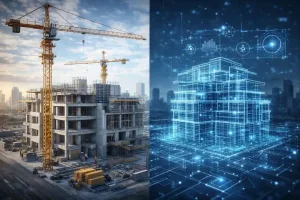
The support of traditional practices with digital technologies has become a strategic necessity in terms of keeping costs under control, completing projects on time and increasing field safety. It is of critical importance for Turkish contracting companies, which hold a strong position on a global scale, to take a leading role in this transformation process for both sustainable growth and the preservation of international competitiveness.
RESEOURCE:
World Economic Forum. (2016). Shaping the Future of Construction: A Breakthrough in Mindset and Technology. Geneva: World Economic Forum.
McKinsey & Company. (2017). Reinventing Construction: A Route to Higher Productivity. McKinsey Global Institute.
Deloitte. (2020). The Future of Construction: Digital Transformation in Engineering and Construction. Deloitte Insights.
Autodesk. (2022). State of Design & Make Report. Autodesk Research.
Aladağ, H. (2022). A Research on Digital Transformation Applications in the Turkish Construction Sector. Journal of Engineering Sciences and Design, 10(3), 973–986.
Share!
Other Blog Posts
Other Blog Posts
Digital transformation is a process in which companies respond to […]


Included in the R4 class of structural repair mortars with high compressive strength, epoxy repair mortars are ideal for safe and permanent repairs in...

Wet areas are parts of a building where water and moisture are present in high amounts, often coupled with insufficient ventilation.
Historical buildings are not only architectural treasures that carry traces of the past to the present but also unique structures that shed light on e...

Advanced engineering solutions and high-performance structural reinforcement techniques not only extend the lifespan of existing buildings but also en...

Waterproofing of buildings is of vital importance to enhance the durability of structures and ensure their longevity.

Today, industrial adhesives have become one of the most important solutions for safely and durably joining different materials, such as metal, iron, a...

POLYMERA MS 960 WINDSHIELD automotive glass adhesive is a reliable solution for vehicle glass assembly, offering strong adhesion, high elasticity, and...

Ceramic materials are widely used in both interior and exterior architectural applications due to their durability, aesthetic appeal and resistance to...